EssaysBased on What?
A Series Name Is Not a Configuration
In building products, ratings attach to a certified build, not a series name. Wrong quotes start where the two get confused.
By Jason MurphyPublished 12 min read

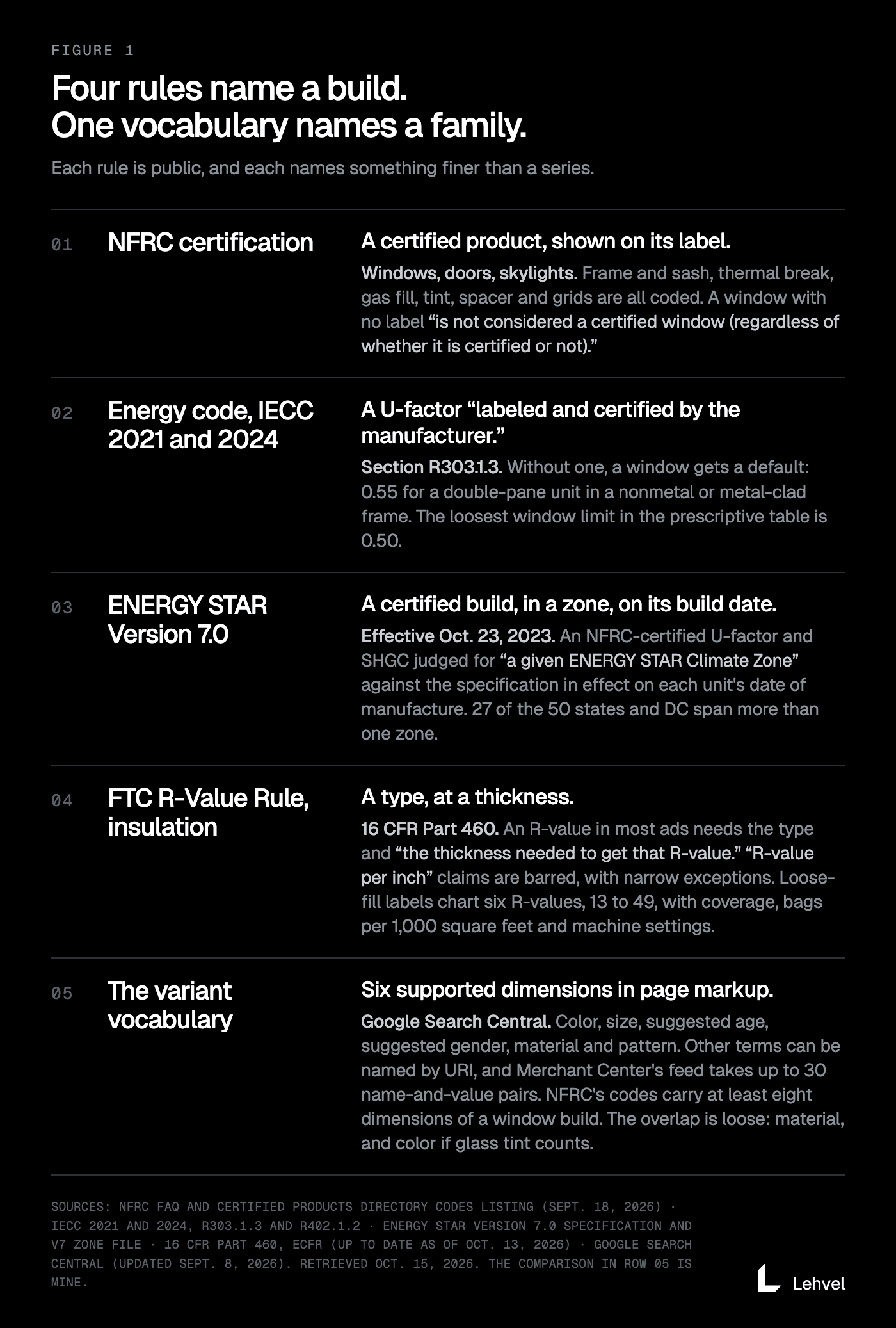
Among the questions the National Fenestration Rating Council (NFRC) answers on its public FAQ page is one that begins at a sales counter. A buyer has a product with no NFRC label on it, “but the retailer is saying that it is NFRC-certified.” NFRC's answer: “If the product does not have a sticker on it, it is not considered a certified window (regardless of whether it is certified or not). Labels CANNOT be e-mailed, faxed, or sent separately from the window.” [1]
The retailer might be right. The product might even be certified. NFRC's answer makes that beside the point: certification is something the unit in front of you shows, on the unit, and a true sentence from the counter does not transfer it. A page NFRC wrote for code officials makes a parallel point about paper. In its commercial program the document is a project-specific label certificate, and the page says: “Manufacturer-provided data and simulation reports from a lab are NOT a substitute for an NFRC label certificate.” [2] [3]
This series is named for a question: based on what? In building products the question has a second half: at what grain? The unit of risk here, the thing a wrong statement is actually wrong about, is the configuration. A rating or an approval is issued for one specific configuration: this frame, this glass, this gas fill, this thickness, this climate zone, this date. The public rules for windows and insulation below show that. Websites, PDFs, line cards and AI answers speak at the grain of a series name; that part is interpretation, and I did not measure it. The gap between the two grains is where a wrong quote starts.
Terms first. By series I mean the name a manufacturer gives a family of products. By configuration I mean the specific combination a rating or approval was issued for, and a configuration that has been certified I call a build. NFRC's explainer for its door label uses the middle word: the circled value is “the rating a specific door has received based on its glass configuration.” [3]
Four rules, four grains
Start with windows. NFRC rates windows, doors and skylights by simulation validated with physical testing, lists the results in a public directory, and requires the label on the product. [4] Its main search returns “only products with a current certification,” and a separate label-verification search “will return results for any product (historical or current) that used that number,” so a number on a label can be looked up after the product is no longer current. [5]
The code listing behind the directory, dated September 18, 2026, shows what a certified build is made of. It defines code tables for product type, frame and sash material, thermal-break material, gas fill, tint, spacer, grids and grid size, with more for doors and for shading and dynamic glazing. The spacer table alone runs three pages, which is a lot of ways to keep two panes of glass apart. [6]
NFRC's own word for a family is “product line,” and its submission types show how a certified one changes under you. Options can be added “into an existing series of grouped certified individual products” or “to the end of a certified product line,” options can be revised or replaced “due to inaccurate or incomplete information,” and the status codes include suspension, revocation and “Failed Performance Challenge.” [6]
The building code asks for the same kind of record. Both the 2021 and the 2024 International Energy Conservation Code (IECC) require a window's U-factor to be “labeled and certified by the manufacturer,” and say that “Products lacking such a labeled U-factor shall be assigned a default U-factor.” The default for a double-pane window in a nonmetal or metal-clad frame is 0.55. The loosest window limit in the prescriptive table is 0.50, and the code has trade-off paths besides. [7] NFRC's page for code officials allows simulation reports at the plan and permit stage but says to “ask for an NFRC label certificate” before signing off on the completed project. [2]
Insulation names its grain differently, and the Federal Trade Commission's R-Value Rule reaches the people who sell the product, distributors and retailers included. [8] An R-value in an ad has to come with the type of insulation and “the thickness needed to get that R-value,” except in television, radio and space-constrained ads. Claims of “R-value per inch” are barred, with narrow exceptions, and installers are told not to multiply the one-inch figure by the inches installed. A loose-fill label charts six R-values from 13 to 49 with coverage and bags per 1,000 square feet, and has to name the “blowing machine and machine settings” behind the installed thickness. [8] The energy code then has the installer's certificate for blown-in fiberglass and cellulose list six facts, among them settled thickness, installed density and number of bags. [7] A retailer that sells insulation to do-it-yourself customers online has to put the label and fact sheet, or a direct link to them, “in close proximity to the covered product's price” on each web page with a detailed description of the product and its price. A seller that is not the manufacturer may rely on the manufacturer's R-value data unless it knows or should know the data is false or not based on proper tests. [8]
ENERGY STAR adds a zone and a date to NFRC's ratings. The Version 7.0 specification asks for an NFRC-certified U-factor and solar heat gain coefficient (SHGC) that meet the criteria “for a given ENERGY STAR Climate Zone,” and it judges each unit against “the ENERGY STAR specification in effect on the model's date of manufacture,” a date that “is specific to each unit.” [9] The label follows the unit. ENERGY STAR's buying advice shows one “for a window qualifying in the Northern and North-Central climate zones,” tells shoppers to use its Product Finder to find “product lines certified for your climate zone,” and says that for an off-the-shelf purchase they should look for the label for their zone next to NFRC's on the glass. [10] The manufacturer is also answerable for its authorized representatives, “such as advertising agencies, dealers, and distributors,” following the guidelines on how the mark may be used. [9]
A zone depends on where the window goes, and zones split states. ENERGY STAR publishes its Version 7 zones as a file keyed by ZIP code. I downloaded it on October 15 and counted. It holds 41,697 ZIP codes in 51 jurisdictions, the 50 states and the District of Columbia, and 27 of those contain ZIP codes in more than one zone. No county is split, but in Indiana 47 of the 92 counties are Northern and 45 are North-Central. [11]
What a series name can carry
The commerce side has established vocabulary for families. CSI describes MasterFormat, whose 2026 edition adds 2,185 new listings and reorganizes 617, as the industry's standardized language for project documentation, one that organizes specifications “into work results that contractors can price, procure, and build.” [12] The schema.org vocabulary defines a ProductGroup as “a group of Products that vary only in certain well-described ways,” and says the group itself “is not directly offered for sale.” The variants are. [13] Google's feed rules follow the same logic. Variants share an item group ID, each variant is its own item, and an item's price must match its landing page while its availability must match the landing page and the checkout, or the product can be disapproved. [14]
Here is the one comparison I ran: two public vocabularies side by side, no company's pages. Google's documentation for product-variant markup lists six supported properties a group can vary by: color, size, suggested age, suggested gender, material and pattern. Its examples of products sold in variations are apparel, shoes, furniture, electronic devices and luggage. [15] NFRC's code listing carries at least eight dimensions of a window build. [6] They overlap loosely: on material, and on color if you count glass tint.
The vocabulary is not closed. The schema.org vocabulary lets a site name other variant properties by URI, and Google's product feed has a variant option attribute that takes up to 30 name-and-value pairs for a variant's identifying dimensions, though it lists no schema.org counterpart. [13] [14] So the web can describe a window's glazing, and the feed can carry it. Google's supported markup stops at the six properties above, and anything finer is optional work.
Nobody is at fault. NFRC certifies builds. CSI, Google and schema.org describe families and classify work. Each does its job at its own grain, and none of them owns the join between a family-level page and a certified build. The join is where someone types a quote.
A distributor, made up
Take a made-up distributor with forty people and three branches that delivers across Indiana. Its manufacturer, its Q series and every rating below are made up too. Its website has a page for the Q series double-hung that says “ENERGY STAR certified,” and the manufacturer's PDF lists a U-factor of 0.21 and an SHGC of 0.28, the figures for the configuration with the lowest U-factor in the line. In the yard are pallets of three configurations: A, B and C.
I invented their ratings and checked them against the real Version 7.0 window criteria, Table 1 plus the Northern-zone trades in Table 4, with each unit assumed certified and meeting the air-leakage criterion. “Qualifies” below means exactly that. A (U-factor 0.24, SHGC 0.30) meets the North-Central criteria and no others. B (0.21 and 0.28, the numbers in the PDF) meets Northern and North-Central. C (0.27 and 0.21) meets South-Central and Southern. Against the county counts above, B qualifies in all 92 Indiana counties, A in 45 and C in none. [9] [11]
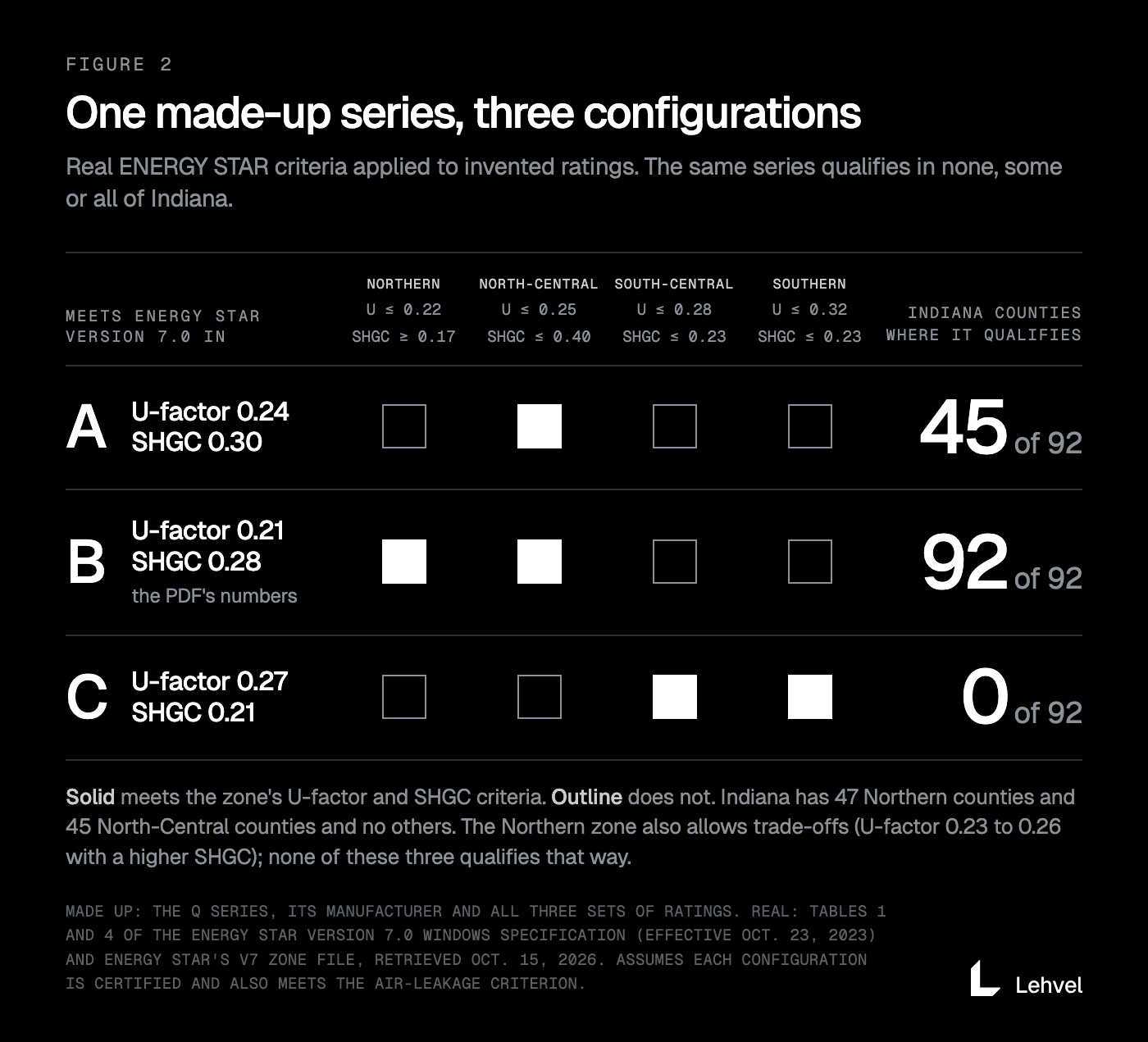
Now a contractor's AI assistant is asked whether the Q series qualifies for ENERGY STAR on a job in a county the contractor names. The page says ENERGY STAR certified and the PDF says 0.21, so the assistant says yes. That is right for B. It is wrong for A in 47 of the 92 counties and wrong for C in all of them, and the pallet that gets picked is C. Nobody lied. The page described a family, the assistant repeated it faithfully, and the one unit that could not qualify in Indiana was the one on the truck. What a wrong yes costs depends on what hangs on the label: a rebate, a spec requirement, a returned pallet. The honest answer depends on three things the page does not name: the configuration, the county and the build date. A unit built before October 23, 2023 was judged against the specification then in effect, an earlier version. [9]
Price and availability have the same shape. A pallet of configuration A at one branch is not “the Q series in stock.” Google's merchant rules say availability “needs to match across all three” of the landing page, the checkout page and the data source, and to use regional availability rather than vary it by a visitor's location. [14] A store can state truthfully only the grain its records hold.
What nobody has measured
There is no rate in this essay. I looked for a public measurement of how often a series-level statement about a building product differs from the certified build and found none. What the rules show does not depend on a rate: wherever one of them applies, the claim has to be about a specific configuration, and a series name is not one.
I did not audit one product family's documentation against the NFRC directory. NFRC's terms of use bar non-members, without written authorization, from “data-scraping, public display, lease, sale or distribution” of its materials, while allowing copies for internal use, so I pulled no directory records, and an audit that cannot name its subject cannot be checked. [16] The format would be the one Lehvel used in a small study in September: a dated sample, a stated source for every figure, conflicts counted apart from unknowns, and the limits printed beside the numbers.
That study was not about building products; I use it for one mechanism. It covered four U.S. businesses, three local service companies and one national retailer, on a provisional record the owners did not confirm, and Lehvel ran it with a stake in the question. Of 135 factual claims that AI assistants made about those businesses, 69 matched a recorded fact, 2 contradicted one and 64 could not be checked because no recorded fact covered them. [17] Hypothesis: in a building-products record, the missing fact is the configuration.
Quote at the grain the record supports
Opinion, and the one place I am proposing rather than reporting: a statement about a rating, an approval, an R-value or an availability should carry the grain it covers, and nobody, human or software, should quote finer than the record supports.
Three habits make that workable. First, the record holds the identifier the label holds. NFRC's label-verification search takes a full CPD number and is “intended to compare the ratings found on your label with those that were certified,” so a record that carries the number can be checked later by anyone. [5] Second, every performance or compliance fact is written with what it covers. “U-factor 0.24” covers a configuration. “ENERGY STAR” covers a configuration, a zone and a build date. An R-value covers a type at a thickness. Third, when the record holds only the series, the answer is limited to what is true of every member, which is how schema.org describes properties set on a group: characteristics “shared by each of the (possibly very many) variants.” [13] Otherwise the answer is “varies,” or a question back: which zone, which thickness, which unit?
Start where a wrong answer is expensive: the series that carry a rating or an approval and sell into more than one zone, and any insulation sold with a price. If you lead a channel for a manufacturer, the same applies one step up. Your series page is what every distributor republishes, so the dimensions you leave off are the ones nobody downstream can restore.
Forecast, held loosely: as more of these questions are answered by software, the grain of the published record will set the grain of the answer, and the series page, being the cheapest thing to read, will be read first.
Here is where I could be wrong
Series-level answers are sometimes exactly right. Some properties are shared by every member of a line, and a statement about them is safe at series grain. Over-precision has a cost too: a quote that arrives with six questions attached may never get sent. The test is whether the statement is true of every member, and a record can check that where a page cannot.
The evidence is rules, not practice. I audited no one's website or PDFs and tested no assistant on a building-products question. ENERGY STAR's Product Finder is outside what I read, so I do not know how it lists a line whose configurations qualify in different zones. If manufacturers and distributors already publish at configuration grain, the gap is smaller than drawn here, and the people reading this know their own data better than I do.
Windows and insulation are two categories. Lumber, roofing, adhesives, fasteners and tile have grains of their own, and I have not read their standards. The energy code text I cite is model code. ICC's adoption notice has each jurisdiction's governing body adopt it and enact its own changes, and where a local rule differs, the local rule controls. [7]
Models will get better at asking. They will. A better assistant can ask which zone. It cannot answer from a record that has no zone in it.
A statement your company makes about a rating, an approval or an R-value is a statement about a configuration, unless every member of the series shares it. Before the next catalog refresh, feed project, website rebuild or assistant pilot, ask the question this series is named for. Which configuration is this statement about? Where is its certificate? What does the record say it covers, and what does it leave out? How would we find out if the unit on the pallet disagreed?
Based on what?
Right action needs right information.
Jason Murphy writes Based on What? for Lehvel. The study's method and limits are on Lehvel's research page.
Also on Medium
Notes and sources
All sources were fetched at the primary publisher on October 15, 2026 (the retrieval date). Most had also been read on October 14, and the two copies matched. Page quotations were read from the fetched text. Help and program pages carry no publication date, so only their retrieval date is given.
- National Fenestration Rating Council (NFRC), “Frequently Asked Questions,” windows, doors and skylights. https://nfrc.org/windows-doors-skylights/faq/. Undated page. Entry: “My product does not have a NFRC label on it, but the retailer is saying that it is NFRC-certified. What should I do?” Retrieved October 15, 2026.
- NFRC, “Code Officials” (commercial program section). https://nfrc.org/commercial/code-officials/. Undated page. Retrieved October 15, 2026.
- NFRC, home page, section “What does the NFRC label tell you?” (door label text; label certificates “are used in commercial buildings and are project-specific”). https://nfrc.org/. Undated page. Retrieved October 15, 2026.
- NFRC, “Residential Product Certification.” https://nfrc.org/residential/. Undated page. Retrieved October 15, 2026.
- NFRC, Certified Products Directory search page (“Find Ratings for NFRC Certified Products” and “Label Verification”). https://search.nfrc.org/search/searchDefault.aspx. Undated page. See also “NFRC Certified Products Directory,” https://nfrc.org/certified-product-directory/. Retrieved October 15, 2026.
- NFRC, “NFRC Certified Products Directory Codes Listing,” 20-page PDF dated September 18, 2026 (product type, frame and sash, thermal break, gas fill, tint, spacer, grid, grid size, door and shading codes; report types; product line status codes). https://cdn.ymaws.com/nfrccommunity.org/resource/resmgr/cpd-2_0info/nfrc_cpd_code_listing.pdf. Retrieved October 15, 2026.
- International Code Council, International Energy Conservation Code, residential provisions, 2021 edition (version Sep 2021) and 2024 edition (version May 2024); both are labeled “Historical” on ICC's site. Sections R303.1.1, R303.1.3 and R303.1.4, Table R303.1.3(1), Table R402.1.2. https://codes.iccsafe.org/content/IECC2021P2/chapter-3-re-general-requirements, https://codes.iccsafe.org/content/IECC2021P2/chapter-4-re-residential-energy-efficiency, https://codes.iccsafe.org/content/IECC2024P1/chapter-3-re-general-requirements, https://codes.iccsafe.org/content/IECC2024P1/chapter-4-re-residential-energy-efficiency. Adoption by a jurisdiction's governing body, with its own changes: “Adoption of International Code Council Codes and Standards,” 2024 IECC preface, https://codes.iccsafe.org/content/IECC2024P1/preface. Retrieved October 15, 2026.
- Federal Trade Commission, “Labeling and Advertising of Home Insulation” (R-Value Rule), 16 CFR Part 460, as published on the Electronic Code of Federal Regulations (eCFR reported Title 16 up to date as of October 13, 2026; source 44 FR 50242, August 27, 1979; the credit lines of the sections cited end at 84 FR 20790, May 13, 2019, and eCFR's version history lists its latest change to the part, to section 460.17 and Appendix A, as May 26, 2021). Sections 460.3, 460.8, 460.12, 460.14, 460.17, 460.18 and 460.20. I am reading the text, not giving legal advice. https://www.ecfr.gov/current/title-16/part-460. Retrieved October 15, 2026.
- U.S. Environmental Protection Agency, ENERGY STAR Program Requirements for Residential Windows, Doors, and Skylights, Version 7.0 (PDF created October 18, 2022; effective October 23, 2023): Partner Commitments, Eligibility Criteria Tables 1 and 4, and sections 3 to 5. https://www.energystar.gov/sites/default/files/ES_Residential_WDS_V7_Final%20Specification%202022.pdf. Retrieved October 15, 2026.
- ENERGY STAR, “Residential Windows, Doors & Skylights” (buying guidance, including the caption of its sample label; “Current Specification Effective Date: October 23, 2023”). https://www.energystar.gov/products/res_windows_doors_skylights. Undated page. Retrieved October 15, 2026.
- ENERGY STAR, “Windows, Doors, and Skylights Climate Zone Finder,” and its spreadsheet “V7 ES Zones by Zip Code.” https://www.energystar.gov/products/building_products/residential_windows_doors_and_skylights/climate_zone/search and https://www.energystar.gov/sites/default/files/asset/document/ClimateZones_County.xls. Undated. My counts from the file: 41,697 ZIP-code rows; 51 jurisdictions; 27 with more than one zone; 3,136 county codes, none in more than one zone; Indiana 92 counties (47 Northern, 45 North-Central). Retrieved October 15, 2026.
- Construction Specifications Institute, “MasterFormat 2026” and “CSI Standards.” https://www.csiresources.org/standards/masterformat2026 and https://www.csiresources.org/standards/overview. Undated pages. Retrieved October 15, 2026.
- schema.org, “ProductGroup.” https://schema.org/ProductGroup. Current schema.org release 30.1, September 16, 2026 (https://schema.org/docs/releases.html). Retrieved October 15, 2026.
- Google Merchant Center Help, “How to fix: Mismatched product price,” https://support.google.com/merchants/answer/12159029; “How to fix: Inaccurate availability,” https://support.google.com/merchants/answer/10725932; and “Product data specification” (item group ID and variant option attributes), https://support.google.com/merchants/answer/7052112. Undated help pages. Retrieved October 15, 2026.
- Google Search Central, “Product variant structured data (ProductGroup, Product),” last updated 2026-09-08 UTC. https://developers.google.com/search/docs/appearance/structured-data/product-variants. Retrieved October 15, 2026.
- NFRC, “Terms of Use.” https://nfrc.org/terms-of-use/. Undated page. Retrieved October 15, 2026.
- Lehvel, study observations in “How customers find a business when AI answers first,” published September 29, 2026 (data collected September 25, 2026). https://lehvel.com/research/ai-discovery-2026. Figures re-derived from the stored study data on October 15, 2026: 69, 2 and 64 of 135. Study run by Lehvel, not independent. Retrieved October 15, 2026.